
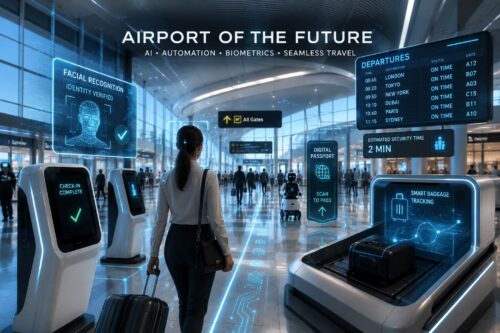
For decades, airports have remained relatively unchanged. Long queues, security checks, passport control and baggage collection have defined the travel experience for millions of passengers worldwide.
However, artificial intelligence is beginning to transform every stage of modern air travel.
In 2026, airports are rapidly evolving into highly intelligent environments powered by automation, biometric identification and predictive technologies.
The goal is simple: make travel faster, safer and more efficient than ever before.
What once seemed like science fiction is becoming reality as airports around the world embrace artificial intelligence to redesign the passenger experience.
The Rise of Smart Airports
Smart airports use advanced technologies to improve operations and reduce inefficiencies.
Artificial intelligence systems analyze enormous amounts of real-time data, allowing airports to optimize passenger flow, security procedures and airline operations.
Instead of relying solely on human decision-making, intelligent systems continuously monitor activity and identify opportunities for improvement.
This creates more efficient travel experiences while reducing operational costs.
Facial Recognition and Biometric Travel
One of the biggest changes taking place in modern airports is the adoption of biometric identification systems.
Facial recognition technology allows passengers to verify their identity without repeatedly presenting passports or boarding passes.
By comparing biometric information with secure databases, AI systems can confirm identities within seconds.
This significantly reduces waiting times and streamlines the passenger journey from check-in to boarding.
AI and the End of Airport Queues
Long waiting lines have traditionally been one of the most frustrating aspects of air travel.
Artificial intelligence is helping airports reduce congestion by predicting passenger flow in real time.
By analyzing flight schedules, security checkpoints, weather conditions and passenger behavior, AI systems can anticipate bottlenecks before they occur.
This allows airports to dynamically allocate staff and resources where they are needed most.
In the future, waiting in long airport queues may become increasingly rare.
Smart Luggage and Automated Baggage Handling
Lost luggage has been a common problem in global air travel for decades.
Artificial intelligence and smart tracking systems are transforming baggage management through automation and real-time monitoring.
Modern AI systems can track luggage throughout its journey, identify routing errors and predict potential delays before they happen.
Some airports are already testing autonomous robots capable of transporting baggage with minimal human intervention.
These innovations aim to create more reliable and efficient travel experiences for passengers worldwide.
Personalized Travel Experiences
Artificial intelligence is also making air travel more personalized.
Future airport systems may provide customized recommendations based on passenger preferences, travel history and real-time needs.
AI-powered applications could suggest:
- faster routes through the terminal
- restaurant recommendations
- shopping offers
- lounge access opportunities
- gate change notifications
This level of personalization could significantly improve the overall passenger experience.
Digital Passports and Identity Verification
Physical travel documents may eventually become less important as digital identity systems continue evolving.
Future airports could rely heavily on secure biometric profiles stored digitally and verified through artificial intelligence systems.
Passengers may be able to move through multiple checkpoints using facial recognition alone.
This would reduce paperwork while increasing efficiency and security.
How AI Improves Flight Operations
Artificial intelligence is not only transforming passenger experiences. It is also revolutionizing airport operations behind the scenes.
AI systems can analyze weather patterns, aircraft schedules and operational data to improve efficiency across entire airport networks.
Predictive algorithms help airlines optimize routes, reduce delays and improve fuel efficiency.
These improvements benefit both passengers and the aviation industry as a whole.
Robots in Airports
Robotic technologies are becoming increasingly common within smart airports.
Some airports are already using autonomous robots to provide customer assistance, perform cleaning tasks and support operational logistics.
Future robotic systems may assist passengers directly by answering questions, providing directions and offering multilingual support.
As artificial intelligence continues advancing, robots may become familiar features of everyday travel experiences.
The Data Behind Modern Travel
Every interaction within an airport generates valuable operational data.
Artificial intelligence systems analyze passenger movement, security trends, boarding behavior and facility usage to improve airport performance continuously.
This data-driven approach allows airports to make more informed decisions and adapt rapidly to changing conditions.
The future of air travel will increasingly depend on intelligent systems capable of learning and improving over time.
The Transition Toward Fully Intelligent Airports
The aviation industry is moving steadily toward highly automated and interconnected travel ecosystems.
Artificial intelligence, robotics and biometric technologies are creating airports that can operate more efficiently, securely and intelligently than ever before.
This transformation represents one of the most significant technological shifts in modern transportation.
AI-Powered Security Screening
Airport security remains one of the most important aspects of air travel.
Artificial intelligence is helping security teams analyze baggage scans, identify suspicious patterns and improve threat detection capabilities.
Machine learning systems can process images faster than traditional methods and assist human operators in identifying potential risks.
As these technologies improve, airport security may become both more effective and less disruptive for passengers.
Predicting Passenger Behavior
Modern AI systems are increasingly capable of predicting passenger movement throughout airports.
By analyzing historical data, flight schedules and real-time activity, algorithms can anticipate congestion and optimize resource allocation.
This allows airports to deploy staff more efficiently and reduce delays in critical areas.
Predictive technology is becoming one of the most valuable tools in airport management.
The End of Traditional Check-In?
Artificial intelligence may eventually eliminate many traditional airport procedures.
Future passengers could move through airports using biometric verification alone, without physical documents or manual check-in processes.
Digital identities and automated systems may handle much of the administrative work currently performed by airport staff.
This could dramatically simplify the travel experience.
Will Airports Eventually Operate Without Human Staff?
As automation technologies continue advancing, some experts believe airports may eventually operate with significantly fewer human employees than today.
Artificial intelligence systems are already capable of handling check-in processes, identity verification, baggage tracking and customer assistance.
Future airports could rely on autonomous systems to manage many routine tasks traditionally performed by staff.
While human oversight will likely remain important, automation may dramatically change how airport operations are organized.
The Privacy Challenges of Biometric Travel
The expansion of biometric identification raises important questions about privacy and data security.
Facial recognition systems require the collection and storage of highly sensitive personal information.
Although these technologies can improve efficiency and security, they also create concerns regarding surveillance and data protection.
As smart airports become more common, balancing convenience and privacy will become increasingly important.
Artificial Intelligence and Travel Decisions
Future AI systems may not only assist passengers but also make operational decisions automatically.
Algorithms could optimize boarding procedures, manage airport traffic, coordinate gate assignments and respond to disruptions faster than traditional systems.
By processing enormous amounts of real-time information, AI can identify patterns and opportunities for improvement that would be difficult for humans to detect manually.
This could create more efficient and resilient transportation networks worldwide.
The Airport Experience in 2035
By 2035, the airport experience may look dramatically different from today.
Passengers could travel through terminals using biometric identification alone, without physical boarding passes or passports.
AI assistants may provide real-time guidance throughout the journey, while autonomous systems manage baggage and security operations seamlessly in the background.
Waiting times could be reduced significantly as predictive systems optimize passenger movement continuously.
The result may be a travel experience that feels almost invisible compared to traditional airport procedures.
Hyper-Personalized Travel
Artificial intelligence is expected to make travel increasingly personalized.
Future systems could adapt airport services based on individual preferences, travel habits and real-time needs.
From personalized navigation to customized shopping recommendations, AI may create unique travel experiences tailored to each passenger.
This shift reflects a broader trend toward personalization across the digital economy.
The Risks of Over-Automation
While automation offers many benefits, excessive dependence on intelligent systems may also introduce new risks.
Technical failures, cybersecurity threats and algorithmic errors could affect critical travel operations.
As airports become more interconnected and data-driven, maintaining system resilience and security will be essential.
Future aviation infrastructure must balance innovation with reliability and trust.
The Future of Global Travel
Artificial intelligence is not simply improving airports. It is helping redefine how people move around the world.
Smart infrastructure, predictive technologies and automated systems are creating a future where travel becomes faster, more efficient and increasingly connected.
The transformation of airports may serve as a preview of how intelligent technologies will reshape transportation on a global scale.
Final Conclusion
Airports are entering a new era powered by artificial intelligence, automation and biometric technologies.
From facial recognition and predictive analytics to autonomous baggage systems and personalized travel experiences, AI is transforming every stage of the passenger journey.
While challenges related to privacy and security remain, the future of air travel appears increasingly intelligent, efficient and connected.
In the coming decades, the airport may evolve from a place of queues and paperwork into a seamless digital environment designed around speed, convenience and intelligent automation.