
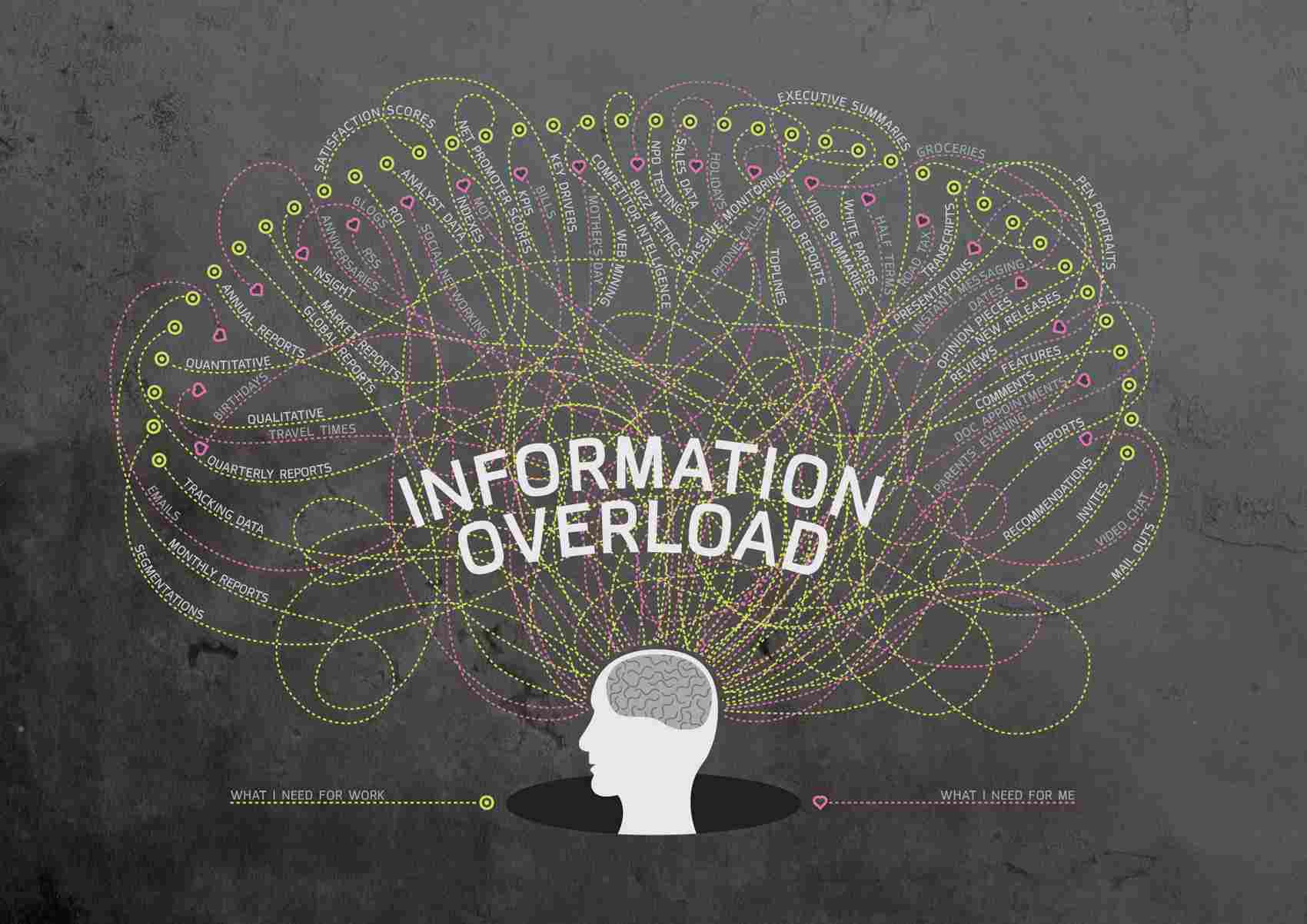
A deep, research-based exploration of how constant information exposure affects daily life, mental clarity, and decision-making.
Introduction: Living in a World That Never Stops Talking
We live in an era where information is always available, always updating, and always demanding attention. News alerts arrive every hour, social media feeds refresh endlessly, messages expect immediate replies, and algorithms constantly suggest what we should read, watch, or think next.
For many people, the problem is no longer a lack of information, but an excess of it. This constant exposure creates a mental state where the mind feels permanently occupied, even during moments that should feel calm or simple.
This phenomenon is known as information overload, and in daily life it has become one of the main causes of mental fatigue, stress, and reduced clarity.
What Is Information Overload?
Information overload occurs when the amount of information a person receives exceeds their brain’s capacity to process it effectively. When this happens, understanding, decision-making, and focus all begin to decline.
The human brain evolved to process information slowly and selectively. In contrast, modern digital environments expose us to large volumes of fragmented, emotionally charged, and often irrelevant information.
According to cognitive load theory, the brain has limited working memory. When that capacity is exceeded, mental performance deteriorates.
How Information Overload Shows Up in Everyday Life
Information overload is not always obvious. It rarely feels dramatic — instead, it shows up as constant mental noise.
- difficulty concentrating on simple tasks
- feeling mentally “full” or scattered
- decision fatigue and indecision
- reduced patience and irritability
- constant urge to check updates
- trouble relaxing without stimulation
Many people interpret these symptoms as personal weaknesses, when in reality they are predictable responses to excessive information input.
Why Modern Technology Intensifies Information Overload
1. Endless Content Streams
Social media platforms, news apps, and video feeds are designed to never end. The absence of natural stopping points prevents mental closure.
2. Algorithmic Prioritization
Algorithms favor emotionally stimulating content. This keeps attention engaged but increases cognitive and emotional strain.
3. Multi-Source Consumption
Many people consume information from multiple platforms simultaneously, increasing mental fragmentation.
4. Perceived Urgency
Notifications and breaking news create the illusion that all information is urgent, even when it is not.
The Cognitive Cost of Too Much Information
Excessive information input taxes several cognitive systems at once:
- Working memory: becomes overloaded
- Attention: becomes fragmented
- Decision-making: slows down
- Emotional regulation: weakens
Research referenced by the American Psychological Association links information overload to higher stress levels, reduced productivity, and increased risk of burnout.
Information Overload vs. Knowledge
Information overload does not mean learning too much. In fact, true learning often decreases when information is excessive.
Knowledge requires:
- time for processing
- reflection
- context
- integration
Constant input leaves little room for these processes, resulting in shallow understanding rather than insight.
Why the Brain Struggles to Filter Information
The brain relies on attention filters to decide what matters. When input is constant, these filters become overwhelmed.
Over time, this leads to a state where everything feels equally important, which increases anxiety and mental exhaustion.
How Information Overload Affects Mental Health
Chronic information overload is associated with:
- anxiety
- sleep disturbances
- irritability
- difficulty concentrating
- emotional fatigue
According to Healthline, constant information exposure can keep the nervous system in a low-level stress state.
Practical Strategies to Reduce Information Overload
1. Reduce Information Sources
Fewer sources mean less cognitive strain. Choose quality over quantity.
2. Create Information Boundaries
Schedule specific times for consuming news and updates.
3. Stop Multiplatform Consumption
Avoid consuming similar information across multiple platforms.
4. Introduce Information-Free Time
Silence and low stimulation allow the brain to recover.
5. Externalize Information
Write things down instead of trying to remember everything.
Long-Term Benefits of Reducing Information Overload
- improved focus
- clearer thinking
- better emotional regulation
- reduced anxiety
- more intentional learning
External References
American Psychological Association – Stress & Information Load
Healthline – Information Overload
NCBI – Cognitive Load Theory
Harvard Business Review – Managing Information Overload
FAQs
Is information overload unavoidable today?
No. While information is abundant, exposure can be managed intentionally.
Does reducing information mean being uninformed?
No. It means choosing information more consciously.
How quickly can mental clarity improve?
Many people notice changes within days of reducing input.
Is scrolling a form of rest?
No. Scrolling increases cognitive stimulation.
Conclusion
Information overload is not a personal failure — it is a structural problem of modern life. Learning to manage information input is one of the most important skills for mental clarity today.
By reducing excess input and creating intentional boundaries, it is possible to think more clearly, feel calmer, and regain a sense of mental space in everyday life.