
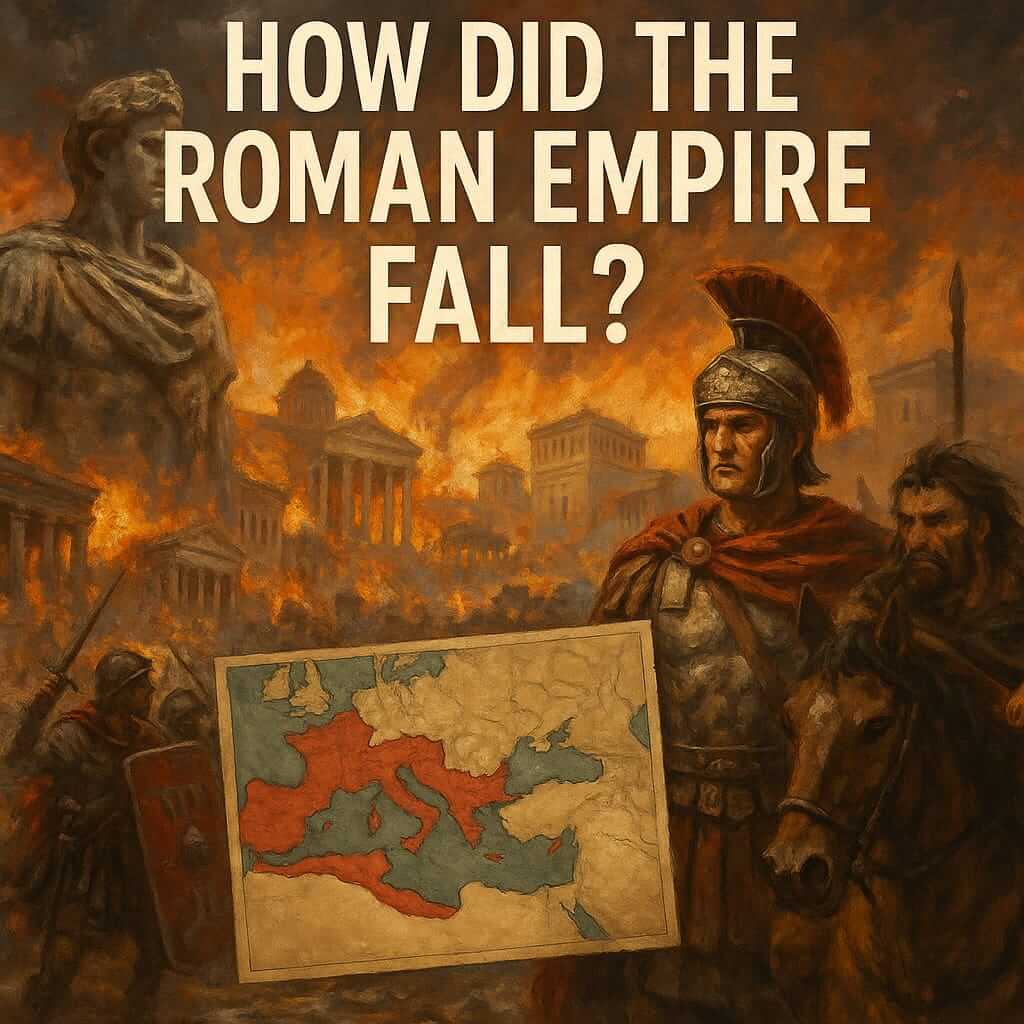
How Did the Roman Empire Fall? Complete Timeline and Detailed Causes Explained
Hi! The fall of the Roman Empire is one of history’s greatest turning points — a superpower that dominated for over five centuries collapsed into ruins. Was it sudden, or a slow decay? In this detailed and evidence-based guide, we’ll walk through the full timeline from the height of Rome’s power to its final collapse in 476 AD, analyzing economic, military, political, and social causes. You’ll also learn how climate change, pandemics, and leadership crises accelerated the decline, and why the Eastern Roman Empire (Byzantium) survived for 1,000 more years. Packed with historical data, scholarly insights, and pro tips for history enthusiasts, this is your complete roadmap to understanding why Rome fell — and why it still matters today.
The Western Roman Empire fell in 476 AD when Emperor Romulus Augustulus was deposed by the Germanic leader Odoacer. However, its decline began centuries earlier due to economic collapse, military overextension, corruption, barbarian invasions, and the split into East and West in 395 AD. The Eastern Empire survived as Byzantium until 1453 AD.
Full Guide: The Fall of Rome – Timeline and Root Causes Explained
The Roman Empire didn’t fall overnight — it crumbled gradually under internal decay and external pressure. From Augustus’ empire in 27 BC to the fall of the West in 476 AD, Rome’s story is one of expansion, glory, and eventual collapse. Below you’ll find a chronological breakdown with verified data from historians such as Edward Gibbon, Peter Heather, and Kyle Harper, along with modern archaeological and environmental evidence.
1. The Rise of Rome (27 BC – 180 AD): Seeds of Decline
The empire reached its golden age under the Pax Romana (27 BC – 180 AD). Population exceeded 70 million, trade flourished, and infrastructure advanced. Yet even during prosperity, problems brewed — overexpansion drained the treasury, reliance on slave labor reduced innovation, and inequality grew. The Antonine Plague (165–180 AD) killed up to 10 million people, weakening both the army and the economy. The assassination of Emperor Commodus in 192 AD ended the era of stability.
2. The Crisis of the Third Century (235–284 AD): Collapse and Chaos
This was Rome’s first great collapse — 26 emperors in 50 years, most killed violently. The empire fractured into rival states like the Gallic Empire and Palmyrene Empire. Inflation reached 1,000%, silver coins became worthless, and foreign invasions by Goths and Persians ravaged the frontiers. Diocletian’s reforms later stabilized the empire, but deep damage was done.
Economic Causes: Currency debasement, halted trade, food shortages.
Military Causes: Civil wars, recruitment crises, barbarian mercenaries.
Social Causes: Epidemics and declining civic loyalty.
3. Constantine and the East–West Split (284–395 AD)
Constantine the Great (306–337 AD) reunited Rome and legalized Christianity with the Edict of Milan (313 AD). He moved the capital to Constantinople (330 AD), ensuring the East’s survival. But this shift weakened the West — tax revenue and population flowed eastward. By 395 AD, Emperor Theodosius I permanently divided the empire between his two sons: Honorius (West) and Arcadius (East).
4. The 5th Century (395–476 AD): Invasions and Collapse
The final century brought relentless invasions. The Visigoths sacked Rome (410 AD), the Vandals seized North Africa (439 AD), and Attila the Hun terrorized Europe (451 AD). Rome’s army, reduced and demoralized, relied heavily on foreign mercenaries. The empire’s economy disintegrated; Rome’s population fell from 1 million to 50,000. In 476 AD, Odoacer deposed the last emperor, marking the end of the Western Empire.
5. Major Causes of the Fall of Rome
The fall was not due to a single cause but an accumulation of crises. Below are the five main categories identified by modern historians.
5.1 Economic Collapse
Inflation, debased currency, declining trade, and overreliance on slaves crippled Rome. By 400 AD, Western GDP had fallen by 50%. Gold was hoarded by elites, and rural production collapsed.
5.2 Military Overextension and Barbarian Invasions
Rome maintained over 400,000 troops to guard borders stretching 4,000 miles. Costs soared while loyalty fell. Barbarian “foederati” troops filled the ranks but often rebelled. The Battle of Adrianople (378 AD) saw an entire Roman army destroyed by the Goths — a turning point.
5.3 Political Corruption and Leadership Crisis
Between 180 and 284 AD, nearly every emperor was assassinated or overthrown. Senators evaded taxes, and military coups became common. The government’s legitimacy eroded, paving the way for collapse.
5.4 Social Decay and Population Decline
Repeated plagues (Antonine, Cyprian, and Justinian) killed millions. Urban centers shrank, literacy dropped, and public morale vanished. Christianity replaced civic duty with spiritual focus — stabilizing society but weakening traditional institutions.
5.5 Environmental and Climate Change
Scientific studies confirm that volcanic eruptions and cooling temperatures in the 5th–6th centuries reduced harvests and drove migrations. The so-called Late Antique Little Ice Age (536–550 AD) caused famine and instability, worsening the decline.
6. The Legacy of Rome’s Fall
The fall wasn’t the end — it was transformation. The Eastern Roman Empire (Byzantium) endured for 1,000 more years, preserving law, culture, and science. Roman engineering, law, and language shaped Europe and the world. The Renaissance later revived its ideals, proving that Rome never truly vanished.
FAQ – Frequently Asked Questions
Did Christianity cause the fall of Rome?
Answer: No. While it shifted focus from civic duty to faith, it also unified the empire and preserved culture in the East.
Was the fall sudden or gradual?
Answer: Gradual — it took over 200 years from the 3rd-century crisis to 476 AD.
Who was the last Roman emperor?
Answer: Romulus Augustulus, deposed by Odoacer in 476 AD.
What role did barbarian invasions play?
Answer: They were the final trigger — internal weakness allowed them to succeed.
Why did the Eastern Empire survive?
Answer: Stronger economy, fortified capital (Constantinople), and better leadership.
Could Rome have been saved?
Answer: Possibly — reforms like Diocletian’s delayed the fall, but structural decay was too deep.
What can modern nations learn?
Answer: Economic inequality, corruption, and overexpansion destroy even the greatest powers.