When was the last time you memorized a phone number, an address or even a birthday? For most people in 2025, the honest answer is simple: “I don’t. My phone remembers it for me.”
The modern brain is no longer just a storage device for facts, dates and directions. It has become a search engine interface, constantly handing off information to external systems: smartphones, cloud apps, messaging histories, photo archives and search engines.
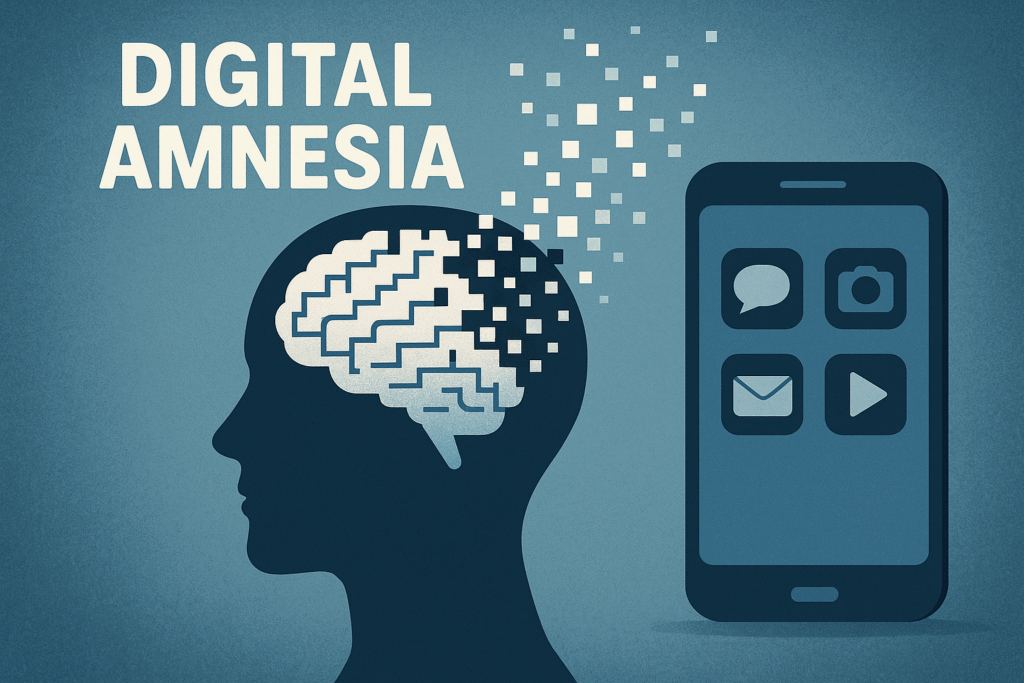
Psychologists and neuroscientists have a name for this phenomenon: digital amnesia — the tendency to forget information that we easily store or access on digital devices. This doesn’t mean the brain is “broken” or “damaged,” but it does mean that the way we remember is changing, and with it, the way we learn, pay attention and build our sense of self.
This article explores what digital amnesia is, how smartphones reshape memory, what science says about the “Google effect,” how this influences relationships, learning, creativity and mental health, and what we can do to build a healthier relationship with digital tools in 2025 and beyond.
What Is Digital Amnesia?
Digital amnesia is not an official medical diagnosis. It is a descriptive term used to capture a very real behavioral shift: the habit of offloading memory tasks to digital devices and, as a result, forgetting information that we would once have remembered.
It includes things like:
- depending on your phone to remember phone numbers, passwords and birthdays
- using maps for every route instead of learning directions
- relying on chat logs and search history instead of recalling conversations
- needing to “Google it” for facts you’ve already looked up many times
- forgetting information quickly because you know you can look it up again later
The core idea is this: if the brain believes information is stored safely elsewhere, it invests less effort in remembering it.
The “Google Effect” on Memory
Early research on this topic sometimes called it the “Google effect on memory.” Experiments showed that when people knew they could easily access certain information again, they were less likely to remember the content itself and more likely to remember where to find it.
In other words, our brains are becoming less like hard drives and more like search bars: we don’t store the full file, we store a pointer to the system that has it.
How Smartphones Became Our External Brain
The idea of outsourcing memory isn’t new — humans have used notebooks, calendars and written archives for centuries. What changed with smartphones is the scale, speed and intimacy of that external memory.
1. Unlimited Storage, Zero Friction
Your phone can store:
- every contact you’ve ever met
- years of photos and videos
- thousands of notes, ideas and reminders
- documents, receipts, bookings and tickets
- a digital archive of your conversations and calls
And all of this is accessible in seconds.
The brain does a simple cost–benefit calculation:
- Memorizing: slow, effortful, limited, easy to forget.
- Offloading to phone: instant, effortless, searchable, permanent (in theory).
So it chooses the second option.
2. The End of “Getting Lost”
Before smartphones, learning your way around a city required attention, repetition and spatial memory. You had to:
- notice landmarks
- build a mental map
- remember distances and routes
In 2025, most people simply:
- open Maps
- follow the blue line
The brain knows the device will repeat the route every time, so it doesn’t encode the path as deeply. That’s digital amnesia in action at the level of spatial memory.
3. Notifications as Memory Triggers
Calendars and reminders have become the external scaffolding of daily life:
- appointments
- medication reminders
- bill payments
- work deadlines
- birthdays and anniversaries
In theory this is helpful. In practice, overreliance can weaken the brain’s own planning and recall systems. If every important action is tied to a notification, the absence of a notification can feel paralyzing.
Is Digital Amnesia Good or Bad?
It’s tempting to say, “This is terrible, technology is destroying our brains.” Reality is more nuanced.
The Upside: Cognitive Offloading as a Feature
Cognitive scientists use the term cognitive offloading to describe how we use tools to reduce mental load.
Offloading memory to devices can be:
- efficient – freeing mental bandwidth for more complex thinking
- inclusive – helping people with ADHD, memory difficulties or high cognitive load
- practical – we face more information daily than any brain can reasonably keep up with
In this sense, digital amnesia is not a “disease” — it’s an adaptation. The brain is smart: it delegates repetitive, low-value storage tasks to external tools.
The Downside: Deeper Memory and Learning May Suffer
But there’s a cost. Not all memory tasks are equal. Some information, like:
- core skills
- emotional experiences
- fundamental knowledge
- language and conceptual frameworks
needs to be encoded inside the brain to support reasoning, creativity and understanding.
If we delegate too much, we risk:
- shallow understanding (“I kind of know it, but I always re-Google it”)
- fragility under pressure (no signal, no battery = no memory)
- weaker long-term recall (we never move information from short-term to long-term storage)
The danger is not that we forget trivia — it’s that we weaken the deep memory structures that support insight, judgment and identity.
Digital Amnesia and the Structure of Human Memory
To understand how smartphones reshape memory, we need a quick look at how memory works.
1. Sensory Memory
This is the ultra-short snapshot of what you see, hear and feel in the moment. Most of it is discarded within seconds unless your attention flags it as important.
2. Short-Term / Working Memory
This is the space where you hold information briefly to use it: a phone number you repeat to yourself, a sentence you’re forming, a step in a recipe. It’s limited — often compared to holding 4–7 “chunks” at a time.
3. Long-Term Memory
This is where knowledge, skills and experiences are stored over time. Moving information from short-term to long-term memory usually requires:
- attention
- repetition
- emotional significance
- contextual use
Digital habits interfere at multiple points in this process.
Continuous Distraction = Broken Encoding
Deep memory requires undivided attention. When the brain is constantly interrupted by notifications, multitasking and app-hopping, the encoding process is disrupted.
You read an article, get a message, check social media, open another app. Later, you know you “saw something about that topic” but can’t recall details. That’s not just fatigue — it’s fractured encoding.
Outsourcing Recall = Weaker Consolidation
Recalling information strengthens memory traces. When you choose to search instead of recall, you skip this natural reinforcement step.
Over time, the brain learns:
- “Why remember it, if I can re-look it up instantly?”
How Digital Amnesia Affects Learning
In education and self-development, memory is not about “being a walking encyclopedia.” It’s about having a solid internal framework that lets you:
- connect ideas
- spot patterns
- think critically
- create new concepts
When learners rely too heavily on devices:
- they may “understand” something only at the surface level
- they jump between sources without fully processing any
- they confuse familiarity (“this looks familiar”) with comprehension (“I truly grasp this”)
The Illusion of Knowledge
Having instant access to information creates an illusion: we feel smart because we can look up anything instantly. But access is not the same as mastery.
A student might say, “I don’t need to memorize formulas, I can always find them.” That’s true for basic tasks — but for higher-level problem solving, the slow process of going back and forth to a search engine breaks focus and blocks deep reasoning.
Reading vs. Scanning
Many people now engage with text by skimming, scanning and grazing through content. This “snack” style of consumption feeds short-term curiosity but rarely builds durable memory.
The brain becomes used to sampling information instead of integrating it.
Digital Amnesia in Relationships and Everyday Life
Memory is not only about facts — it is a key ingredient in relationships and identity.
1. Remembering Details About People
In close relationships, remembering small things matters:
- favorite foods
- important dates
- stories they told you
- moments you shared
When everything is written down in notes or chats, some people stop actively storing these details. They feel like they “care,” but their memory doesn’t reflect emotional investment.
Over time, this can create a subtle emotional distance:
- “You don’t remember what I told you.”
- “We already had this conversation.”
- “It feels like nothing stays with you.”
2. Shared Memories vs. Shared Archives
Couples and friends now rely heavily on:
- photo galleries
- shared albums
- chat histories
This creates a sort of external shared memory. That can be beautiful — but it can also lead to a strange feeling: “If the cloud disappeared, how much of our story would I truly remember?”
3. Identity and Life Narrative
Our memory is the backbone of our personal narrative: how we explain who we are. The more we externalize our memories into feeds, screenshots and archives, the more our narrative becomes intertwined with platforms.
Some people report that their memories feel fragmented, like a highlight reel instead of a lived-through story.
Does Digital Amnesia Damage the Brain Physically?
A common fear is: “Are smartphones causing brain damage? Am I ruining my memory permanently?”
Current science does not support the idea that digital offloading automatically “kills brain cells” or causes direct structural damage in the way a neurological disease would.
However, what it does change is:
- how often we train our memory
- how deeply we encode information
- how we distribute mental effort
The brain is plastic. It strengthens what you use often and prunes what you use rarely. If you train your brain to:
- jump between apps
- scan instead of read
- search instead of recall
…it becomes very good at those habits, and less practiced at:
- holding focus
- memorizing
- reflecting deeply
Digital Amnesia and Anxiety
Ironically, offloading memory to devices can increase anxiety in some people.
Common experiences include:
- panic when the phone is lost or battery dies (“my whole life is in there”)
- constant checking of reminders and notifications
- fear of missing something without an alert
- mental blankness when disconnected (“I don’t know anything without my phone”)
The device becomes a psychological crutch. Instead of supporting memory, it replaces confidence in our own cognitive abilities.
Can We Have the Best of Both Worlds?
The goal is not to go back to a pre-digital world or to throw away smartphones. The real challenge is to use technology consciously so that:
- we benefit from its external memory
- without losing our internal memory strength
1. Decide What You Want Your Brain to Keep
Not everything deserves mental storage. But some things do. Ask yourself:
- What knowledge is part of my craft or passion?
- What information is crucial for my independence?
- What memories feel important to carry inside me, not just on a screen?
For those categories, make an effort to memorize, review and recall — don’t rely solely on devices.
2. Use Devices as Backup, Not Primary Memory
When learning something:
- try to explain it in your own words before looking it up again
- test yourself: “Can I recall the main ideas without checking notes?”
- use notes and apps as safety nets, not first reflexes
3. Practice Deliberate Recall
A simple technique to strengthen memory:
- after reading or watching something important, close the app
- write down or say out loud what you remember
- only then, check the source again to fill gaps
This retrieval practice signals to the brain: “This matters. Store it.”
4. Reduce Fragmentation While Learning
During study or deep work:
- turn off non-essential notifications
- stay in one app or document as long as possible
- avoid jumping to messaging or social feeds mid-task
Fewer interruptions = stronger encoding = less digital amnesia.
5. Strengthen Memory With Offline Habits
Old-school methods still work:
- mnemonics
- spaced repetition
- writing by hand
- teaching others what you learned
These habits build robust mental structures that complement your digital tools instead of competing with them.
Rewriting the Narrative: From “Broken Memory” to “Redesigned Memory”
The story of digital amnesia can be told in two ways:
- Catastrophic version: “Phones are destroying our memory and attention.”
- Adaptive version: “Humans are redesigning how they use memory in a world of abundant information.”
The truth sits somewhere between. We are indeed offloading many memory tasks to devices. And that does change how our minds work. But it’s not too late — or too hard — to choose what we keep inside, and what we outsource.
In 2025, the real question is not:
- “Is digital amnesia real?” (yes, it is)
The better question is:
- “What kind of brain do I want to have in a world where my phone can remember almost everything for me?”
If we use technology intentionally, we can design a memory system that combines:
- the reliability of digital archives
- with the depth, meaning and emotional richness of human memory
Our phones may remember for us — but they cannot remember as us. That part is still uniquely human.
External Sources & References
- Research on the “Google effect on memory” and transactive memory systems.
- Studies on cognitive offloading, smartphone dependence and attention fragmentation.
- Work in cognitive psychology and neuroscience on working memory, long-term consolidation and retrieval practice.
- Digital well-being reports on device overuse, anxiety and perceived cognitive decline.